Skip to content
Vol. I — Autumn 2026
Danicarl Publishing

Where manuscripts become books.

No. 72 · Mathematics teacher and parent edition

The teacher and parent edition of High School Math 3.

High School Math 3

Polynomials, Rational and Exponential Functions, Circles and Inference
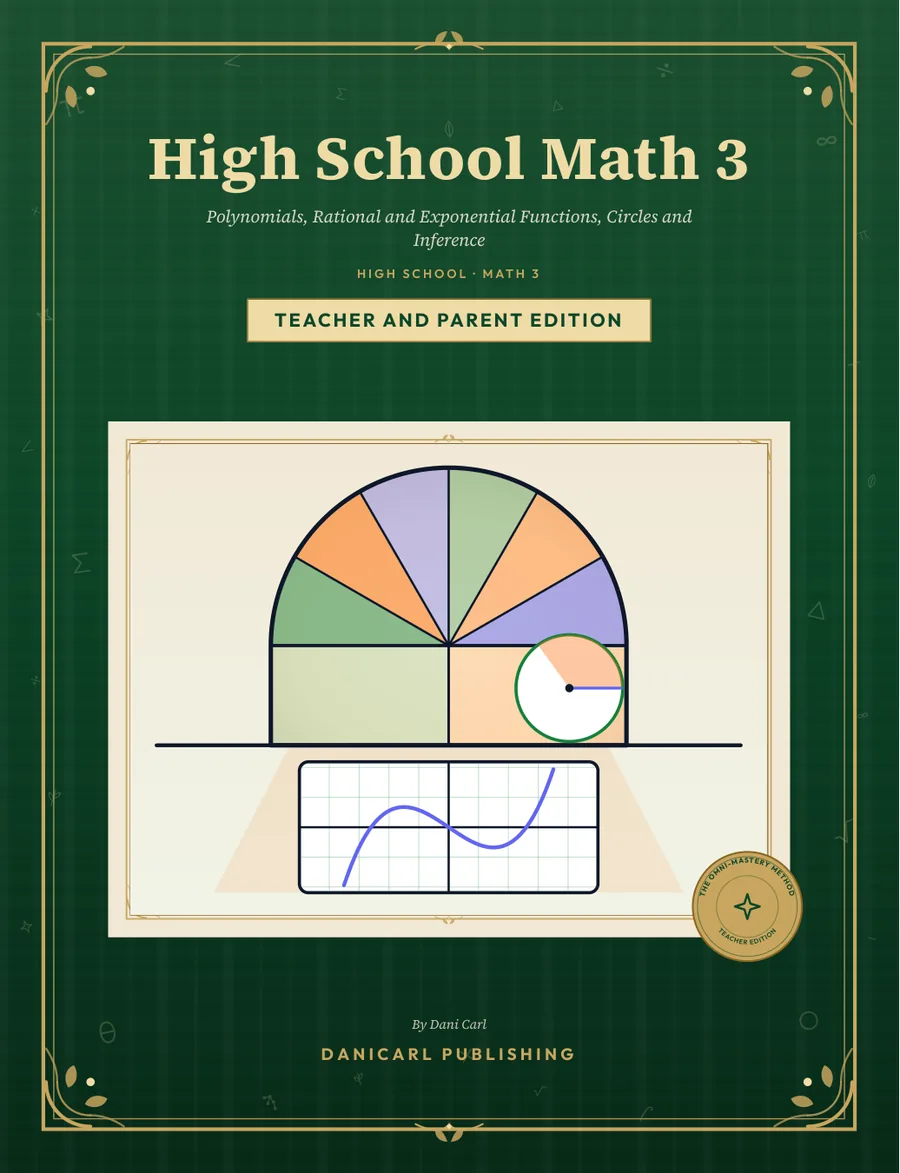
High School Math 3 by Dani Carl — cover
Written by
Dani Carl
Genre
Mathematics teacher and parent edition
Series
The Danicarl Omni-Mastery Series
For
Adult reader (teacher, parent or tutor) working with a student in Grades 10-11, ages 15-17
Pages
250
Published
2026
Catalogue
No. 72
Edition details
Trim
8.5 x 11 in
Binding
Paperback · Matte

The opening

Chapter at a Glance

Try this short activity before reading the lesson.

High School Math 3

Chapter at a Glance · Dani Carl

Chapter at a Glance

  • Chapter: 1
  • Strand: Pure — Change
  • Difficulty: Level 4 of 5
  • Builds on: The quadratic formula and the discriminant, Transforming functions, Polynomials

Try This First

Try this short activity before reading the lesson.

> Take $y=(x+1)(x-2)^2$. Before reading anything, plug in $x=-2$, $x=0$, $x=3$ and just write the sign of each answer. Then mark where $y=0$. You now have enough to draw the shape; do it, and keep the sketch.

Math lab: Predict the shape from signs

Predict first. For $f(x) = (x - 1)(x + 2)$, predict whether the graph is above or below the axis between its zeros.

<div class="math-model"><p><strong>Sign chart. Zeros at −2 and 1.</strong></p><div class="model-bar"><span class="model-cell">x &lt; −2: +</span><span class="model-cell">−2 &lt; x &lt; 1: −</span><span class="model-cell">x &gt; 1: +</span></div><p class="model-caption">Intervals are schematic, not drawn to scale.</p></div>

Model and solve. Test $x = -3, 0, 2$: outputs are $4, -2, 4$. The product is negative between the zeros. Plot the intercepts $(-2,0)$, $(1,0)$ and $(0,-2)$, then sketch the upward-opening parabola.

Spot the bug / explain. A learner says two factors always make a positive product. Use $x=0$ as a counterexample.

Your turn. Find zeros and the negative interval for $(x-2)(x+1)$.

Check after trying. Zeros: $-1$ and $2$; negative for $-1 < x < 2$.

The Big Idea

Far from the origin, only the leading term matters: at $x=1000$, the $x^4$ in $3x^4-5x^3+x$ is a thousand times the next term. So the degree and the sign of the leading coefficient decide the two ends. Even degree: both ends go the same way. Odd degree: opposite ways. Negative leading coefficient flips both.

Near the axis, the factors matter. A zero from a factor to an odd power crosses the axis; a zero from an even power touches and turns back, a bounce, because the sign cannot change there. Between zeros the sign is fixed, so one test point per interval settles it.

The graph can turn at most $n-1$ times for degree $n$. That is a ceiling, not a count.

The leading term decides the ends and the factors decide the middle.

Words to Know

  • End behavior: Where the graph heads as $x\to\infty$ and as $x\to-\infty$. Decided by the leading term alone.
  • Multiplicity: The power on a factor. $(x-1)^2$ gives the zero $1$ multiplicity $2$. Odd: cross. Even: bounce.
  • Turning point: A place where the graph changes from rising to falling or back. Degree $n$ allows at most $n-1$.

Formulas and Theorems

  • End behavior: $p(x)\sim a_n x^n \text{ for large } |x|$
  • Note: Sign of $a_n$ and parity of $n$ decide where the ends point.
  • Multiplicity: $(x-r)^m$
  • Note: Crosses at $r$ if $m$ is odd, bounces if $m$ is even.
  • Turning points: $\le n-1$
  • Note: A degree-$n$ polynomial turns at most $n-1$ times.

Outcomes and Milestones

  • Students can: read degree, leading coefficient and end behavior from standard or factored form; list zeros with multiplicity and say cross or bounce at each; sketch from factored form with one sign check per interval; state the maximum number of turning points as $n-1$.
  • Watch for: $(x+3)^2$ read as a zero at $x=3$; “degree 4 so four turns”; a bounce drawn as a crossing.
  • Ready when: $p(x)=-(x+2)(x-1)^2(x-4)$ sketched with the correct ends, a bounce at $1$, and the sign of $p(0)$ stated without a calculator.

Worked Examples and Your Turn

Study each example, then try the paired problem.

Example 1: The ends from the leading term

Problem: Describe the end behavior of $p(x)=3x^4-5x^3+x$.

Solution:

  • Find the leading term: $3x^4$. Why: for large $|x|$ it swamps everything else, so it alone sets the ends.
  • Degree $4$ is even, coefficient $3$ is positive. Why: $x^4$ is positive on both sides, and multiplying by $3$ keeps it positive.

Answer: Both ends go up: $p(x)\to\infty$ as $x\to\infty$ and as $x\to-\infty$.

> Verification & Check: $p(10)=30000-5000+10>0$ and $p(-10)=30000+5000-10>0$.

Your Turn:

  • Prompt: End behavior of $q(x)=-2x^3+7x$?
  • Answer: Odd degree, negative coefficient: left end up, right end down.

Example 2: Sketch from factored form

Problem: Sketch $p(x)=-(x+2)(x-1)^2(x-4)$ and state the sign of $p(0)$ without a calculator.

The chapter continues in the book.

Page 1 of 1

Editions — sold direct

Delivery
A PDF, on your shelf as soon as payment clears. No account required; a private link is emailed.
Returns
A faulty or undeliverable file is always refunded; not yet downloaded, refunded in full within 30 days. Refunds in full →
Ten or more
Classrooms, teams and book clubs are quoted a volume price and invoiced. Ask for a quotation →
Account
Not needed to pay. The Shelf is where you download the file again later.

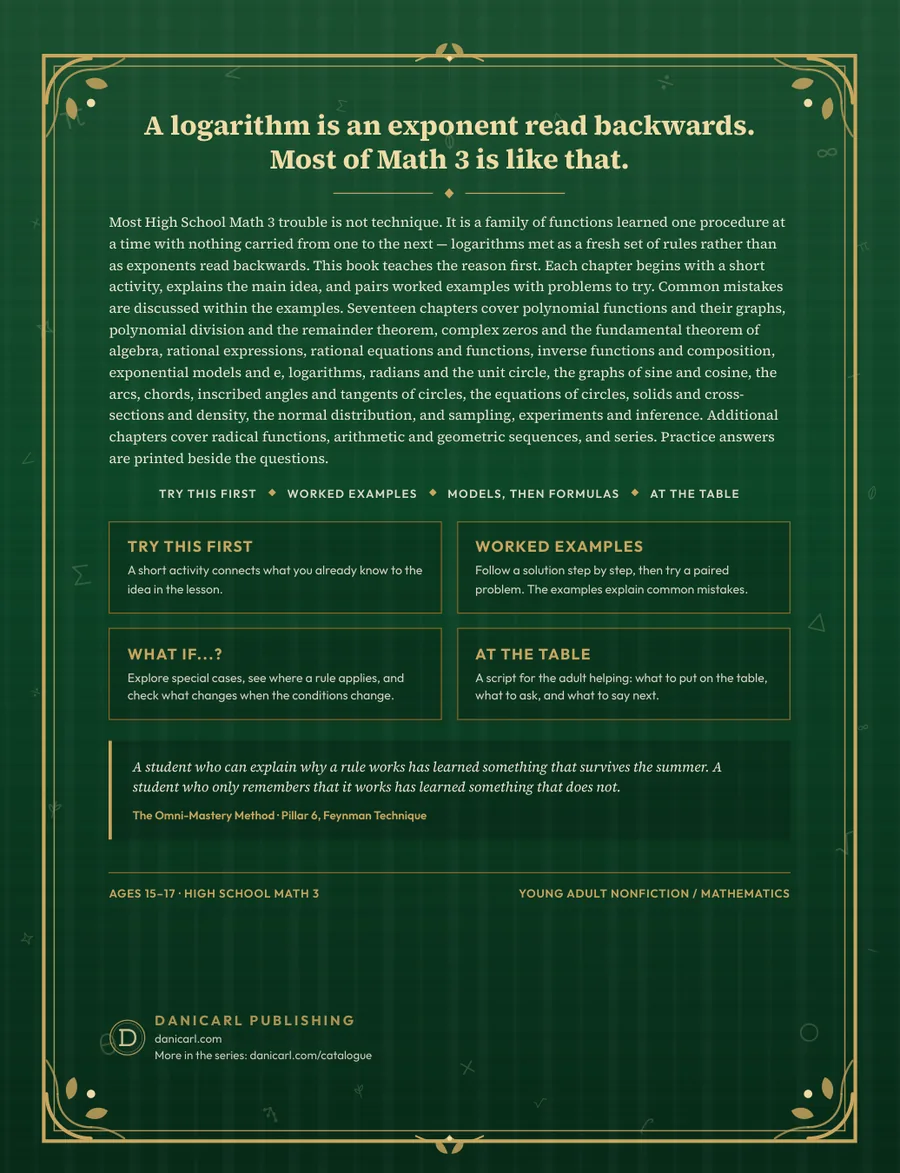
The teacher and parent edition of High School Math 3. It contains all seventeen student chapters, from polynomial functions and the fundamental theorem of algebra through rational functions, inverses, exponentials and logarithms, the unit circle, circles, solids, the normal distribution, inference and sequences, with each Your Turn answer printed under its problem and the answer and working printed under every Try It on Paper problem.

Each chapter adds four sections for the adult. Chapter at a Glance gives the chapter in brief. Outcomes and Milestones states what the student can do afterwards, a misconception to watch for, and a "ready when" check. Exam and Contest Profile has two notes in every chapter: how the skills are asked on standardized tests, and how they appear in math competitions. At the Table is a working script: a hands-on start, questions in order, and what to try when a student is stuck.

A Master Topic Matrix in the front matter shows what each chapter builds on.

Look inside.

Actual edition

The cover and pages below are rendered from the print-ready files for this edition—not a stock mockup.
High School Math 3 — front cover
Front cover
High School Math 3 — back cover
Back cover
High School Math 3 — a page from the interior
A page from the interior