Author's Note
This is a practical book, not a clinical protocol. No study has tested the six-step DECIDE framework as a complete intervention. I built it by combining established ideas from decision science, behavioral psychology, and my own experiments with chronic overthinking. Where the research is mixed, I say so. Where a tool is simply my adaptation, I say that too.
The named people in these pages are illustrative unless I identify a published source. Some examples combine details from research, conversations, and lived experience; others are explicit thought experiments. They are designed to clarify a decision pattern, not to masquerade as clinical case histories.
I am a writer, not a therapist, neuroscientist, lawyer, or financial adviser. Use this framework for ordinary decisions and as preparation for better conversations with qualified professionals. Decisions involving health, safety, abuse, legal rights, or financial security deserve advice from someone trained for the stakes.
Persistent decision paralysis can also accompany conditions such as anxiety, depression, ADHD, or OCD. If choosing has begun to interfere with eating, sleeping, working, leaving home, or staying safe, a mnemonic is not enough. Please seek professional support.
AI is part of how things get written in 2026, and it would be strange to hide that in a book about making honest choices. I drafted this manuscript, did the reading, and built the framework. I used AI tools the way an earlier writer would have used a research assistant — to pressure-test arguments, check citations, and push back when my reasoning got lazy. The decisions on these pages are mine, and so is the responsibility for them.
For everyone else—the person functioning adequately while carrying far too many unresolved choices—let's close a few tabs.
INTRODUCTION: The Most Important Skill Nobody Taught You
I had a book proposal sitting in a Google Doc for fourteen months. Finished. Polished. Ready to send.
I never sent it.
Every week I'd open the document, read the first paragraph, change a comma, change it back, and close my laptop. Fourteen months of this. The proposal didn't improve. The timing didn't ripen. The comma ended up exactly where it started.
That's the story I tell at parties. It's safe. It's self-deprecating enough to be charming without being uncomfortable. People laugh. I laugh. We move on. But it's not the real story — the one that made me write this book. That story involves a hospital room at 2 AM, a phone call from my brother, and a decision I still don't know if I got right. I'll tell you that story at the end. For now, just know: I didn't write this book because I mastered decisions. I wrote it because one decision nearly broke me, and I had to understand why.
But before the hospital, before any of this, there was the couch.
Five months. Eleven stores. Fabric swatches from three manufacturers. A spreadsheet comparing cushion density, frame materials, and warranty terms. One evening I fell down a forum thread — people who had owned their couches for six years and developed opinions about lumbar support that I can only describe as theological. One person wrote nine hundred words about the declining integrity of foam cores in the modern furniture industry. Nine hundred words. About foam. I read all of it. I took notes.
When I finally bought one — gray, mid-century, seventh store, middle of my range — I felt nothing. Not relief. Not satisfaction. Just a low hum of anxiety that I'd missed something better, and a hollow exhaustion, like I'd finished a race that nobody else was running and there was no medal at the end. Just a couch. A fine couch. A couch that took five months of my life.
I read restaurant menus like legal documents. I keep seventeen browser tabs open for purchases I won't make for weeks. Once — genuinely, not an exaggeration — I spent forty-five minutes on a streaming service, read descriptions of twenty films, watched three trailers, and went to bed without watching anything. I consumed an entire evening's worth of deciding about entertainment without consuming any entertainment. That felt like a metaphor for something, but I was too tired to figure out what.
So when I tell you I wrote a book about decisions, here is the truth of it: I did not write it from mastery. I wrote it because I was drowning, and I needed to build something to hold on to.
It started, as these things do, with a question I couldn't stop picking at: why are smart people so bad at making decisions?
Not life-or-death decisions. Not the ones with genuinely catastrophic stakes. The ordinary ones. The job offers, the apartment hunts, the "should I have this conversation or let it go" ones. The decisions that shouldn't consume weeks of mental energy but somehow do. The ones that make you feel like you're doing something important — all that research, all that deliberation — when what you're actually doing is hiding.
I started reading. Decision science papers. Behavioral economics. Cognitive psychology. I read Daniel Kahneman's Thinking, Fast and Slow and felt personally attacked on nearly every page. I read Barry Schwartz's The Paradox of Choice and underlined so aggressively I tore pages. I read Chip and Dan Heath's Decisive, which reorganized things I thought I already knew. I read Annie Duke's Thinking in Bets, Gerd Gigerenzer's Gut Feelings, Gary Klein's Sources of Power. I read the obscure stuff too — replication crisis debates about whether the ego-depletion model holds up, meta-analyses that contradicted the studies I'd just highlighted, dissenting papers that made me question everything I thought I'd learned.
Two years of this. Two years of reading, note-taking, reorganizing, trying to find the shape underneath.
And then testing ideas on my own deeply imperfect decision-making.
Here's what I found, and I'm going to be more honest about this than most authors would be, because I think the honesty matters more than the pitch: the research is extraordinary. It is. Psychologists and economists and neuroscientists have been studying decisions for decades and they've produced genuinely useful work. But — and I almost didn't include this "but" because it complicates the narrative — for every study I found illuminating, I found another that contradicted it. For every clean framework, I found a replication failure. For every confident conclusion, I found a footnote that said "more research needed." The science of decision-making is brilliant AND messy, and any book that presents it as purely brilliant is selling you something.
What I can tell you is this: even with the mess, the practical implications converge. The researchers disagree about mechanisms but agree about patterns. And the patterns, organized into something usable, are worth your time. The problem isn't the research. The problem is that almost none of it is organized in a way a normal person can use on a Tuesday afternoon when they're staring at two job offers and their stomach hurts.
The research lives in journals. In 400-page textbooks. In conference papers with titles like "Antecedent Conditions and Decisional Procrastination: A Temporal Motivation Theory Perspective." And look — I don't blame the researchers. That's their job. Their job is to be precise and cautious and to qualify every finding with appropriate caveats about sample size and replication and ecological validity. That's good science. But there's a gap between knowing that humans are predictably irrational and actually doing something about it at 11 PM when you're spiraling about whether to text your ex back.
This book is my attempt to bridge that gap.
You may have seen the claim that an adult makes 35,000 decisions per day. There is no dependable count: the answer changes radically depending on whether turning your head, choosing a word, or postponing a reply qualifies as a decision. The impressive number is less useful than the ordinary observation. A day contains more choices than we can consciously track, and the unresolved ones keep demanding attention after the moment of choice has passed.
I started calling that cumulative weight the Phantom Weight.
You know the feeling. You've had a day where you did nothing particularly hard — no crisis, no deadline, no emotional confrontation — and by 7 PM you're gutted. You sit on your couch (the one that took you five months to choose) and you can't figure out why you're so tired. You didn't do anything. Except you did. You carried things. The apartment you haven't committed to. The conversation you keep rehearsing but never having. The career change you've been "thinking about" for two years. The email draft you revised four times and never sent. None of them urgent. All of them heavy. Not the weight of action — the weight of suspension. Every unmade decision is a browser tab you can't close, silently draining the battery of a machine you need for other things.
The Phantom Weight doesn't come from the decisions themselves. It comes from the fact that they're unresolved. Sitting in your cognitive RAM. Humming. You stop noticing the hum the way you stop noticing a refrigerator — but the electric bill keeps climbing.
From the research, I pulled together a framework. Six steps. I gave it an acronym because I have the kind of brain that forgets things without one, and because — I'll admit this — acronyms sell books. I'm not proud of that. But here we are.
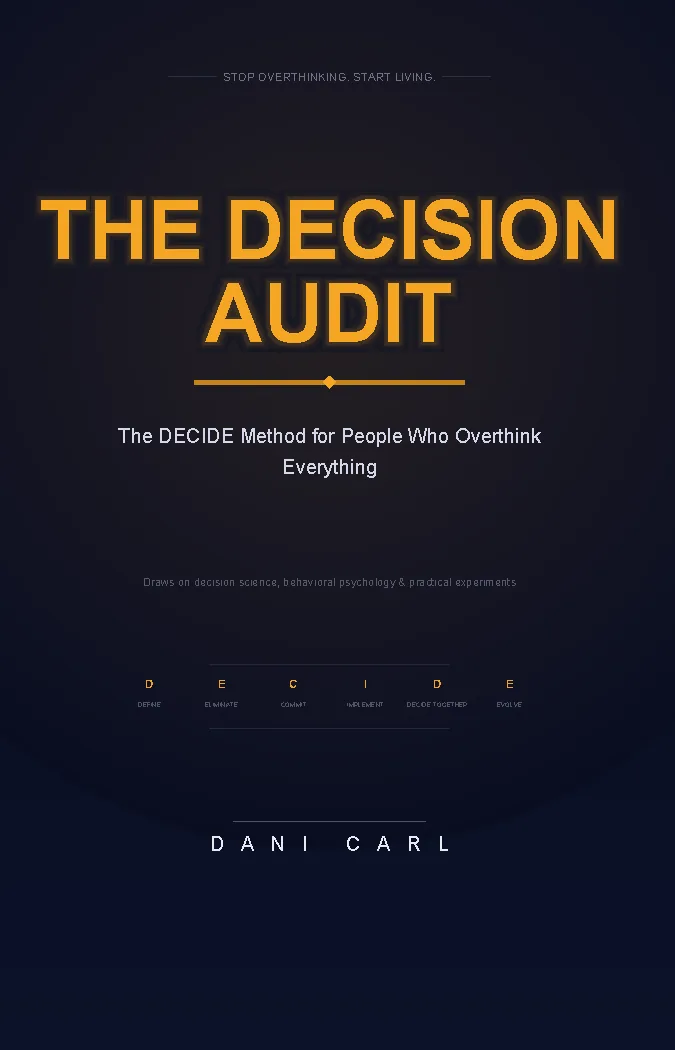
DECIDE.
D — Define what you actually want. E — Eliminate noise and narrow your options. C — Commit fully and stop looking back. I — Implement immediately. D — Decide Together, when the choice isn't yours alone.
The chapter continues in the book.